
East Point Personal Injury Lawyer
Personal Injury Lawyer East Point, GA
If you have been injured in an accident in East Point, you may be facing painful injuries, mounting medical bills, missed income, and pressure from an insurance adjuster who has already started building a file against you. Our East Point, GA personal injury lawyer at Council & Associates can explain how Georgia law applies to your case and what categories of compensation may be available to you.
Our firm has represented injury victims throughout south Fulton County and across Georgia for more than 20 years. We understand how insurance carriers approach personal injury claims, including the tactics used to minimize injuries, dispute causation, and shift fault onto the injured party. A personal injury case involves more than the incident itself. It requires careful documentation of injuries, long-term medical needs, lost income, and the conduct of the party whose negligence caused the harm.
Contact us for a free case review. No fees are owed unless we recover compensation on your behalf.
Why Choose Council & Associates for Personal Injury Cases in East Point, GA?
Over Two Decades of Georgia Injury Experience
Our firm has handled personal injury matters throughout Georgia for more than two decades. We understand how the state’s negligence principles, comparative fault framework, and insurance regulations interact in claims arising from motor vehicle collisions, premises incidents, commercial trucking, rideshare crashes, and catastrophic injuries. The legal analysis is rarely simple, and insurance carriers routinely rely on procedural delays and adjuster tactics to reduce what they owe.
Proven Case Results
Our firm has secured millions of dollars through personal injury, trucking, and daycare abuse matters. Every client receives the same level of care and attention, regardless of the size of the claim.
Contingency Fee Structure
Our cases are accepted on a contingency fee basis. There are no upfront costs, no hourly billing, and no retainer. Clients pay a percentage of the recovery only if the case is settled or won. If no compensation is obtained, no fee is owed.
Attorneys With Deep Roots in This Community
Our founder, Lashonda Council-Rogers, is admitted to practice in Georgia and South Carolina. She has been recognized as a Super Lawyer, named an “Attorney to Watch” by Attorney at Law Magazine, and listed among the Top 10 Georgia Trucking Lawyers by the National Trial Lawyers. She serves on the executive board of the Gate City Bar Association and holds active memberships with the Atlanta Bar Association, the Georgia Trial Lawyers Association, the Georgia Association of Black Women Attorneys, and the American Bar Association. Attorney Wayne Washington is also admitted to the Georgia bar and handles personal injury matters for the firm.
The following testimonial reflects the experience of a recent client:
⭐⭐⭐⭐⭐
“I had a great experience working with Council & Associates! From start to finish, everyone I spoke with was professional, friendly, and easy to reach whenever I had questions. They kept me informed every step of the way, whether by email, text, or phone, and made the whole process smooth and stress-free. On top of that, they secured the maximum payout for my case, which was a huge win. I highly recommend them to anyone looking for a reliable and results-driven legal team!” – Kevin Diggs
Additional reviews are available on our Google Business Profile.
Types of Personal Injury Cases We Handle in East Point
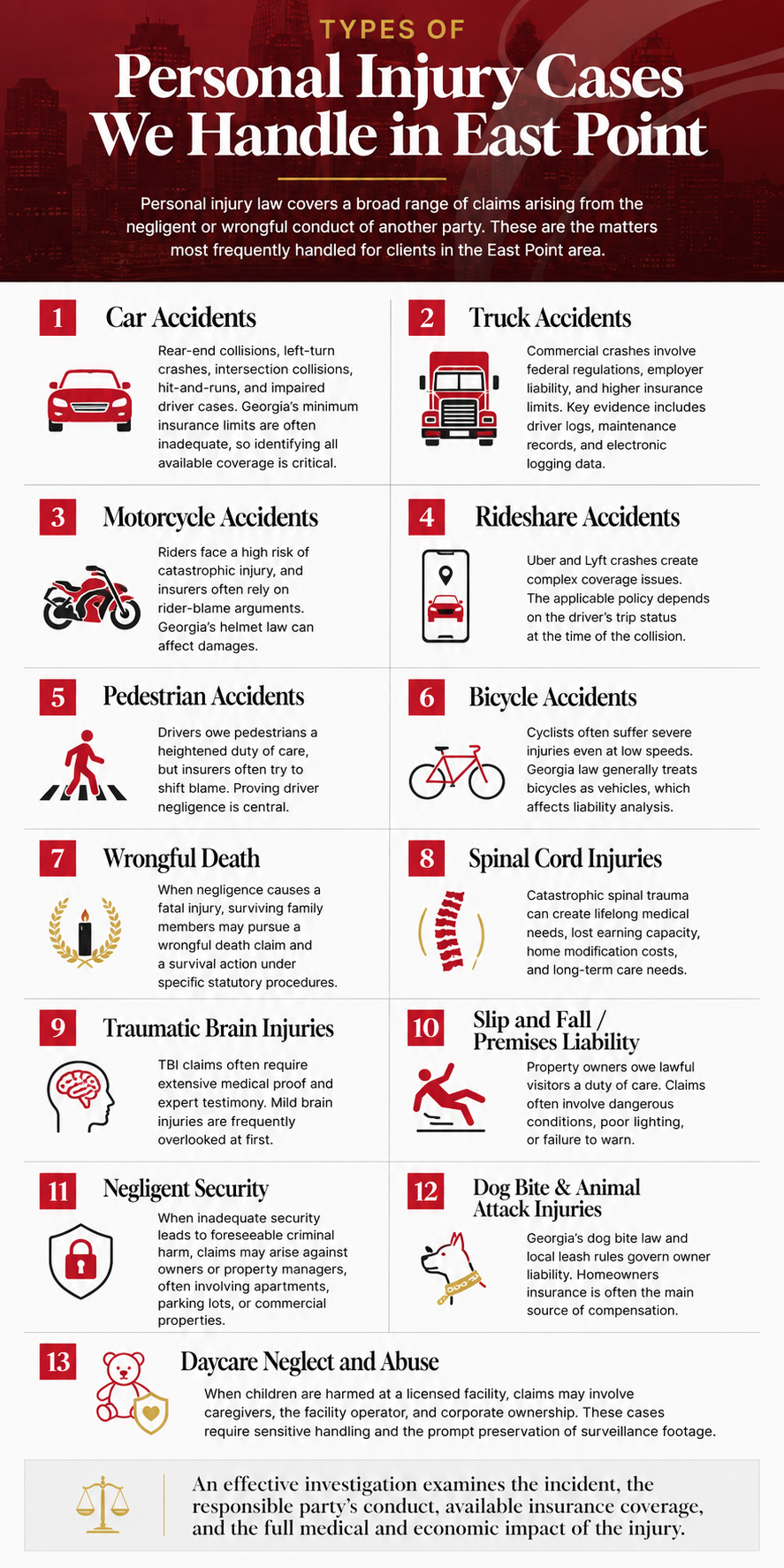
 Personal injury law covers a broad range of claims arising from the negligent or wrongful conduct of another party. The matters below represent those our firm most frequently handles for clients in the East Point area.
- Car accidents. Rear-end collisions, left-turn crashes, intersection collisions, hit-and-run incidents, and impaired driver cases. Georgia’s compulsory insurance minimums are frequently inadequate for serious injury, which makes identifying all available coverage a central task.
- Truck accidents. Commercial vehicle crashes involve federal regulations, employer liability, and significantly higher insurance limits than passenger car cases. Investigation requires preservation of driver logs, maintenance records, and electronic logging device data.
- Motorcycle accidents. Riders face disproportionate risk of catastrophic injury, and insurers routinely rely on rider-blame narratives to reduce payouts. Georgia’s universal helmet law affects the presentation of damages.
- Rideshare accidents. Uber and Lyft crashes raise complex coverage questions. The applicable policy varies based on what phase of the trip the driver was in at the time of the collision.
- Pedestrian accidents. Drivers owe a heightened duty of care to pedestrians under Georgia law, but insurance carriers frequently attempt to shift blame to the injured walker. Proving driver negligence is central to these cases.
- Bicycle accidents. Cyclists struck by motor vehicles suffer severe injuries even at low speeds. Georgia law treats bicycles as vehicles for most traffic purposes, which affects the liability analysis.
- Wrongful death. When negligence causes a fatal injury, surviving family members may pursue both a wrongful death claim and a survival action. These matters are governed by specific statutory procedures.
- Spinal cord injuries. Catastrophic spinal trauma often results in lifetime medical needs, lost earning capacity, and the cost of home modification and long-term care. Life care planning is essential to valuing these claims.
- Traumatic brain injuries. TBI cases require extensive medical evidence and often expert testimony to establish the nature and permanence of cognitive and behavioral changes. Many mild traumatic brain injuries are initially overlooked in emergency care.
- Slip and fall and premises liability. Property owners owe a duty of care to lawful visitors. Claims arise from dangerous conditions, inadequate lighting, and failure to warn about known hazards.
- Negligent security. When a property owner fails to provide reasonable security measures and a foreseeable criminal act causes harm, a claim may lie against the owner or property management company. Apartment complexes, parking lots, and commercial properties are common settings.
- Dog bite and animal attack injuries. Georgia’s dog bite statute and local leash ordinances govern owner liability. Homeowners insurance is typically the primary source of compensation.
- Daycare neglect and abuse. When children are harmed at a licensed facility, claims may lie against individual caregivers, the facility operator, and any relevant corporate owner. These matters require sensitive handling and preservation of surveillance footage.
Our investigation examines the circumstances of the incident, the conduct of the responsible party, available insurance coverage, and the full medical and economic impact of the injury.
East Point Personal Injury Infographic
Georgia Legal Requirements for Personal Injury Cases
Georgia personal injury law centers on the common law of negligence, refined and modified by statute. The controlling provisions were enacted by the Georgia General Assembly and are codified primarily in Title 51 of the Official Code of Georgia Annotated.
A negligence claim in Georgia requires proof of four elements: a duty of care owed by the defendant to the plaintiff, a breach of that duty, actual and proximate causation, and compensable damages. The duty of care varies by context. Drivers owe reasonable care to others on the road, property owners owe graduated duties to invitees and licensees, and commercial carriers owe heightened duties to passengers.
The statute of limitations for a personal injury claim in Georgia is two years from the date of injury under O.C.G.A. § 9-3-33. Claims for property damage are governed by a four year deadline under O.C.G.A. § 9-3-32. Wrongful death claims are governed by a two year period running from the date of death under O.C.G.A. § 9-3-33. Claims against governmental entities require an ante litem notice to be served within a short statutory window, which can be as brief as six months.
Georgia applies a modified comparative negligence rule under O.C.G.A. § 51-12-33, a standard enforced by the Georgia Courts in civil injury cases. A plaintiff whose share of fault is less than 50 percent may still recover damages, though the recovery is reduced in proportion to that share of fault.
Punitive damages may be available in cases involving particularly reckless, willful, or malicious conduct. Georgia law caps punitive damages at $250,000 in most cases under O.C.G.A. § 51-12-5.1, though the statute contains several exceptions that can expand the available recovery, including cases involving driving under the influence and products liability.
Under O.C.G.A. § 33-24-56.1, Georgia’s collateral source rule limits the use of evidence concerning payments made by the plaintiff’s own insurance. This principle frequently determines what a jury may and may not consider when valuing medical expenses.
What Damages Are Recoverable in East Point Personal Injury Cases?
Personal injury victims in Georgia may pursue three general categories of damages: economic, non-economic, and, in limited circumstances, punitive.
Economic damages compensate for financial losses that carry a measurable dollar value. These include emergency room charges, surgical costs, hospitalization, rehabilitation and physical therapy, prescription medication, diagnostic imaging, lost wages during recovery, loss of future earning capacity, property damage, and the cost of any long-term or permanent medical care the injury will require. Establishing the full scope of future treatment typically requires medical testimony, and the proper method of proving these damages is often decisive in how an insurer values the case.
Non-economic damages address losses that do not generate receipts. Physical pain and suffering, emotional distress, loss of enjoyment of life, permanent scarring, mobility limitations, and the psychological effects of a traumatic injury all fall within this category. Many injury victims develop persistent anxiety or depression following a serious accident, and those effects are legally compensable.
Punitive damages may be available in cases involving particularly reckless or willful conduct. Common examples include drunk driving, street racing, deliberate disregard for known safety hazards, and intentional misconduct.
Georgia law distinguishes between special and general damages when valuing a case, and both categories apply in most personal injury matters. Insurance carriers frequently press for quick settlements that cover immediate medical expenses while discounting long-term care, lost earning capacity, and psychological effects.
The at-fault party’s liability insurance is the primary source of recovery in most personal injury cases. When that coverage is insufficient, additional coverage may apply under the injured party’s own automobile policy, umbrella policy, or homeowners policy, and in some cases a separate claim may lie against an employer, property owner, product manufacturer, or governmental entity.
What Steps Should I Take After a Personal Injury Accident?
The actions taken in the first hours and days after an injury can significantly affect the outcome of a case. The 10 steps below are those our firm recommends to every client.
- Seek medical attention immediately. Even when injuries appear minor, internal bleeding, concussion, and soft tissue damage frequently present hours or days later. A same-day evaluation creates a medical record tied to the date of the incident.
- Report the incident to law enforcement or property management. Motor vehicle crashes must be reported to police. Premises incidents should be reported to the store manager, property owner, or on-site supervisor and documented in a written incident report.
- Document the scene when safely possible. Photograph the location, any physical evidence of the cause, weather or lighting conditions, and any visible injuries. Evidence disappears within hours of most incidents.
- Identify witnesses. Independent witness accounts frequently determine contested cases. Obtain the name and phone number of any person who observed the incident.
- Preserve physical evidence. Keep damaged clothing, equipment, or footwear that may have contributed to or resulted from the incident. Do not attempt to repair a damaged vehicle before a claim adjuster has inspected it.
- Obtain insurance and contact information. Collect the name, address, phone number, and insurance details of any party whose conduct may have contributed to the injury.
- Report the incident to your own insurance carrier. Prompt notice is typically required under most policies. Provide only basic facts and decline to give a recorded statement until you have spoken with an attorney.
- Keep all medical records and receipts. These are often serious injuries requiring legal representation, and the bills add up quickly. Retain billing statements, prescription records, mileage logs for medical appointments, and documentation of lost income.
- Avoid posting about the incident on social media. Photographs, location check-ins, and commentary can all be used against your claim by defense counsel and insurers.
- Consult an attorney before accepting any settlement offer. Early offers are almost always inadequate. Adjusters reach out quickly and use tactics designed to minimize payouts. Allow legal counsel to evaluate the claim and manage communications with the insurer.
Preserving evidence quickly matters. Surveillance footage is overwritten on a rolling basis, witnesses move or lose recollection, and physical evidence at the scene deteriorates within hours. The earlier an attorney becomes involved, the more likely it is that critical evidence will be preserved.
Personal Injury Statistics in East Point
 Available data demonstrates that personal injuries remain a leading cause of hospitalization, disability, and lost productivity in the United States, and Georgia consistently reports injury rates above the national average.
According to the Centers for Disease Control and Prevention, unintentional injuries are among the leading causes of death across all age groups in the United States, and millions of Americans are treated in emergency departments for injury-related conditions each year.
The National Safety Council estimates that motor vehicle crashes, falls, and workplace incidents together account for the majority of serious personal injury claims nationally. Motor vehicle crashes alone account for hundreds of thousands of emergency department visits annually in Georgia.
The Georgia Department of Public Health tracks injury-related deaths and hospitalizations as part of its injury prevention programs. Falls, motor vehicle crashes, and violence account for the majority of injury-related hospitalizations in the state.
The Bureau of Labor Statistics reports that workplace injuries remain a significant source of personal injury claims, with nonfatal occupational injuries and illnesses occurring in the hundreds of thousands each year. Georgia’s workforce concentration in logistics, construction, and service industries places workers at elevated risk in certain sectors.
The National Highway Traffic Safety Administration reports that more than 40,000 people are killed in motor vehicle crashes nationwide in a typical reporting year and approximately 2.5 million sustain injuries requiring emergency medical treatment. Georgia traffic fatalities typically exceed 1,700 annually.
East Point sits in south Fulton County, adjacent to Hartsfield-Jackson Atlanta International Airport and the Interstate 285 corridor. The area combines heavy commuter traffic, commercial activity, and a dense residential population, all of which contribute to elevated injury incident rates.
The Federal Motor Carrier Safety Administration reports that crashes involving large trucks have increased significantly over the past decade. Commercial vehicle involvement raises both the complexity and the potential exposure of a personal injury claim, and East Point’s proximity to the airport and major interstate routes places residents at elevated risk of commercial vehicle collisions.
East Point Personal Injury Lawyer FAQs
How much does a personal injury lawyer in East Point, GA cost?
Our firm accepts cases on a contingency fee basis. There is no upfront fee and no hourly billing. The client pays a percentage of the recovery only if compensation is obtained. If no recovery is made, no fee is owed.
Do you offer free consultations?
Yes. Every personal injury consultation with our firm is provided at no cost. We review the facts of the incident, answer your questions, and offer a candid assessment of whether the claim is viable.
How long do I have to file a personal injury lawsuit in Georgia?
Two years from the date of the injury. This is the general personal injury statute of limitations in Georgia. Property damage claims are governed by a four year deadline. Claims against governmental entities may require an ante litem notice within as little as six months, so consulting with counsel early is particularly important when a city, county, or state entity may share responsibility for the harm.
What types of cases does your firm handle?
Our firm handles a broad range of personal injury matters, including motor vehicle crashes, commercial trucking collisions, motorcycle accidents, pedestrian and bicycle cases, premises liability, negligent security, dog bites, daycare neglect, and wrongful death. A wide range of personal injury claims arises from similar negligence principles, which lets our experience in one area inform our approach in others.
Can I recover if I was partially at fault?
Georgia’s modified comparative negligence rule permits recovery when the plaintiff is less than 50 percent at fault. Any recovery is reduced by the plaintiff’s share of fault. Insurance adjusters frequently overstate an injured party’s fault, particularly when early statements provide them with language to work with.
What should I expect from my first meeting with a lawyer?
During the initial consultation, we review the facts of the incident, the medical treatment received to date, the available insurance coverage, and any written documentation you have. We then explain the legal options and outline what representation would involve.
Will my case go to trial?
Most personal injury cases resolve before trial. Our firm prepares every matter as though it will be presented to a jury, and that approach strengthens our position during settlement negotiations. When an insurer refuses to offer fair value, we are prepared to try the case.
How is pain and suffering calculated?
Pain and suffering damages do not follow a fixed formula. They are evaluated based on the severity and duration of the injury, the impact on daily life, the permanence of any lasting effects, and the strength of the supporting evidence. Medical records, testimony from treating physicians, and the client’s own account of the impact all contribute to the valuation.
What if the insurance company has already offered me a settlement?
Initial offers are rarely adequate. Insurers issue early offers before the injured party understands the full scope of medical treatment, lost income, and long-term impact. Accepting a quick settlement typically forecloses any additional recovery, even when later complications arise.
Do I need a lawyer for a minor injury?
Injuries that appear minor in the days after an incident can develop into serious long-term conditions. An attorney evaluation costs nothing and protects your rights if the situation worsens. Insurance releases signed without counsel typically bar any future claim on the same incident.
What if the responsible party has no insurance?
Our firm investigates every available source of recovery. Uninsured motorist coverage under your own automobile policy may apply in vehicle cases. In premises matters, the property owner’s liability policy is the typical source. In some cases, claims may also lie against an employer, a property manager, a product manufacturer, or a government entity.
Can I recover for emotional trauma?
Yes. Post-traumatic stress, anxiety, sleep disturbances, and depression are all legally compensable when they are tied to a physical injury or, in limited circumstances, to witnessing a traumatic event involving a close family member. Mental health treatment records help substantiate these elements of the claim.
How long does a personal injury case take?
The timeline depends on the severity of the injury, the complexity of liability, and the insurance carrier’s negotiation posture. Straightforward cases may resolve in several months. Matters involving severe injury, disputed fault, or multiple defendants typically require a year or longer. Our firm moves as quickly as the evidence and the client’s medical recovery permit.
What questions should I ask before hiring an attorney?
Prospective clients benefit from asking about the attorney’s experience in similar cases, their approach to communication, whether the firm handles the case directly or refers it out, and how the contingency fee is structured.
Do I have to go to court to pursue a personal injury claim?
Most personal injury cases resolve through settlement without the injured party ever appearing in court. When a lawsuit becomes necessary, our firm prepares the client carefully for any required appearance. Depositions and mediation more often replace in-court testimony.
Most Dangerous Locations for Personal Injury Incidents in East Point
 East Point sits in south Fulton County, bordered by College Park, Hapeville, and the city of Atlanta, and sees heavy traffic from the Hartsfield-Jackson airport, Interstate 285, and major arterial corridors. The following locations represent those most commonly associated with serious personal injury incidents in the area.
- Interstate 285 through East Point. The perimeter carries heavy commuter and commercial traffic with multiple merge points and high travel speeds. Lane changes, sideswipes, and rear-end collisions dominate the crash pattern.
- Camp Creek Parkway corridor. The route serves a mix of retail, commuter, and airport-related traffic. Multiple signalized intersections and shopping center driveways produce frequent left-turn and intersection crashes.
- Cleveland Avenue. The arterial carries significant commuter volume through residential and commercial zones, with frequent turning movements at commercial driveways.
- Washington Road and Main Street. These routes serve downtown East Point and produce a high rate of intersection crashes due to signalized control and closely spaced driveways.
- Retail centers along Camp Creek Parkway and Washington Road. High-traffic parking lots produce frequent slip and fall incidents, pedestrian strikes, and premises liability matters.
- Apartment complexes in the Cleveland Avenue corridor. Several properties in south Fulton County have generated negligent security claims based on inadequate lighting, broken gates, or failure to respond to known criminal activity.
These descriptions reflect publicly reported crash and incident patterns. Case strategy depends on the specific facts of each matter.
What Are Important Local Resources for East Point Personal Injury Victims?
The following resources may be of use to people injured in East Point. Council & Associates does not endorse and has no affiliation with the organizations listed below. They are provided for reference only.
- East Point Police Department. (404) 761-2177. Responds to collisions and incidents within city limits and prepares incident reports.
- Fulton County Sheriff’s Office. (404) 612-5100. Provides law enforcement services in unincorporated areas of the county.
- Grady Memorial Hospital. (404) 616-1000. The nearest Level I trauma center for catastrophic injuries.
- Wellstar Atlanta Medical Center South. Provides emergency and acute care services for residents of the East Point area.
- Georgia State Patrol. Investigates serious injury and fatal crashes on state routes and interstates.
- Fulton County State Court. The court of general civil jurisdiction for Fulton County, including personal injury matters.
- Georgia Department of Public Health. Publishes injury data and prevention resources relevant to Georgia residents.
Preserve copies of any reports filed with law enforcement, medical providers, or your insurance carrier. These records frequently serve as the evidentiary foundation of a strong personal injury claim.
Contact Council & Associates
A serious injury can result in lasting physical harm, significant loss of income, and long-term emotional consequences. No injured person should be left to bear those costs alone. Our attorneys provide a complimentary initial consultation to review the facts of your case, explain your rights under Georgia law, and outline the available legal options. No fees are owed unless compensation is recovered.
Contact us to speak with an attorney who handles personal injury matters. We respond promptly because physical evidence and witness recollections in these cases deteriorate quickly following the incident.
Visit Our East Point Personal Injury Lawyer Office
Stay In The Know
View our latest legal updates.
Case Results Millions Recovered For Our Clients
$1,750,000
Tractor Trailer Settlement
Our client was crossing one of the busier intersections in Atlanta when a negligent truck driver struck them unexpectedly, suffering a broken hand and leg fracture. We secured a seven-figure settlement for our client’s pain and suffering.
$550,000
Car Accident
Client was driving when their vehicle was overturned by a truck, leaving the client with broken ribs. After hard litigation, our firm won over a half-million dollar settlement for our client’s medical bills and suffering.
$300,000
Commercial Truck Accident
Our client was driving in Atlanta when a commercial truck struck them. The truck driver’s negligence resulted in a left shoulder injury. Following a brief round of negotiations, we were able to settle on a six-figure settlement for our client’s injuries.
Contact Us
To schedule your free initial consultation, complete the contact form below.
Phone Number | (404) 526-8857
24/7 Call Answering